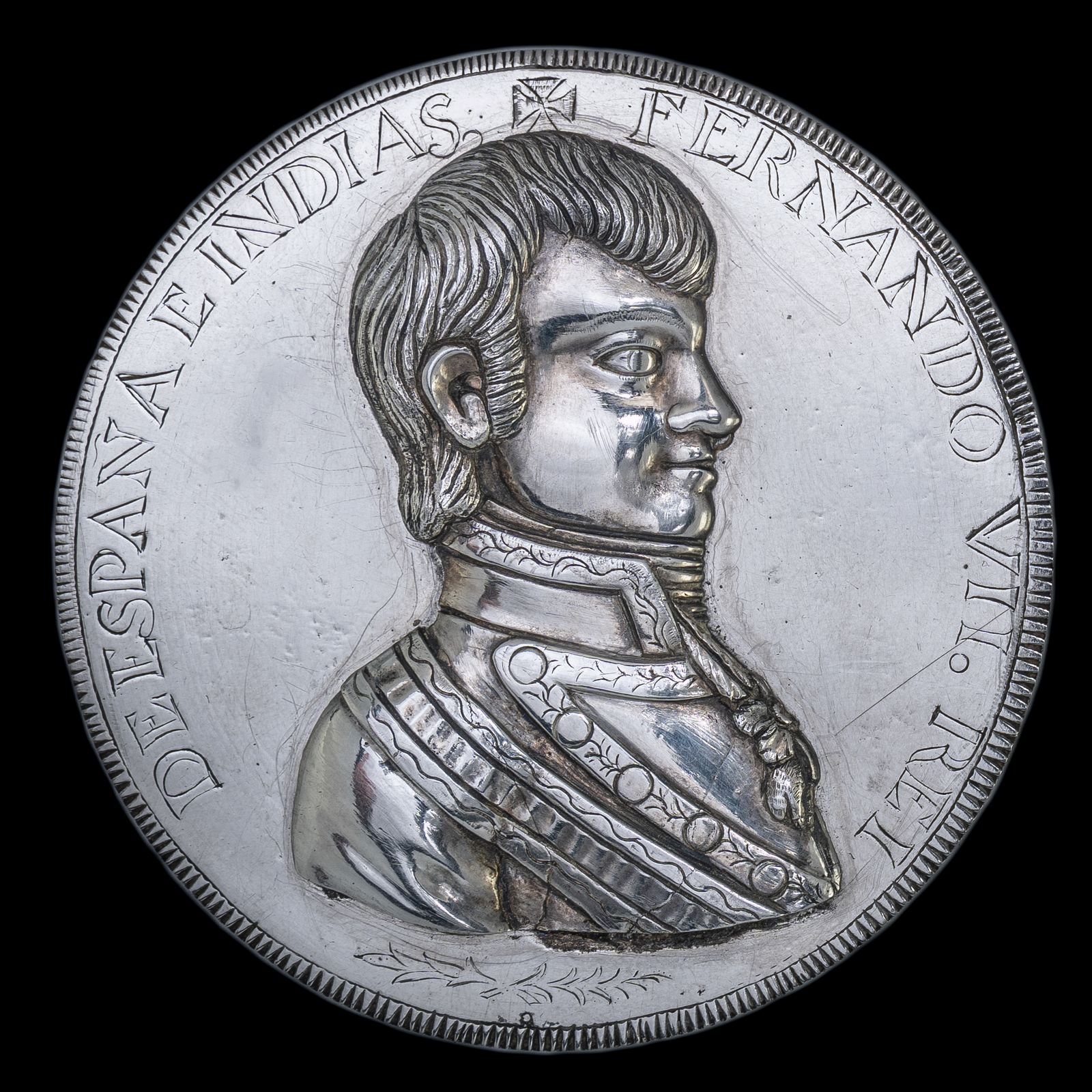
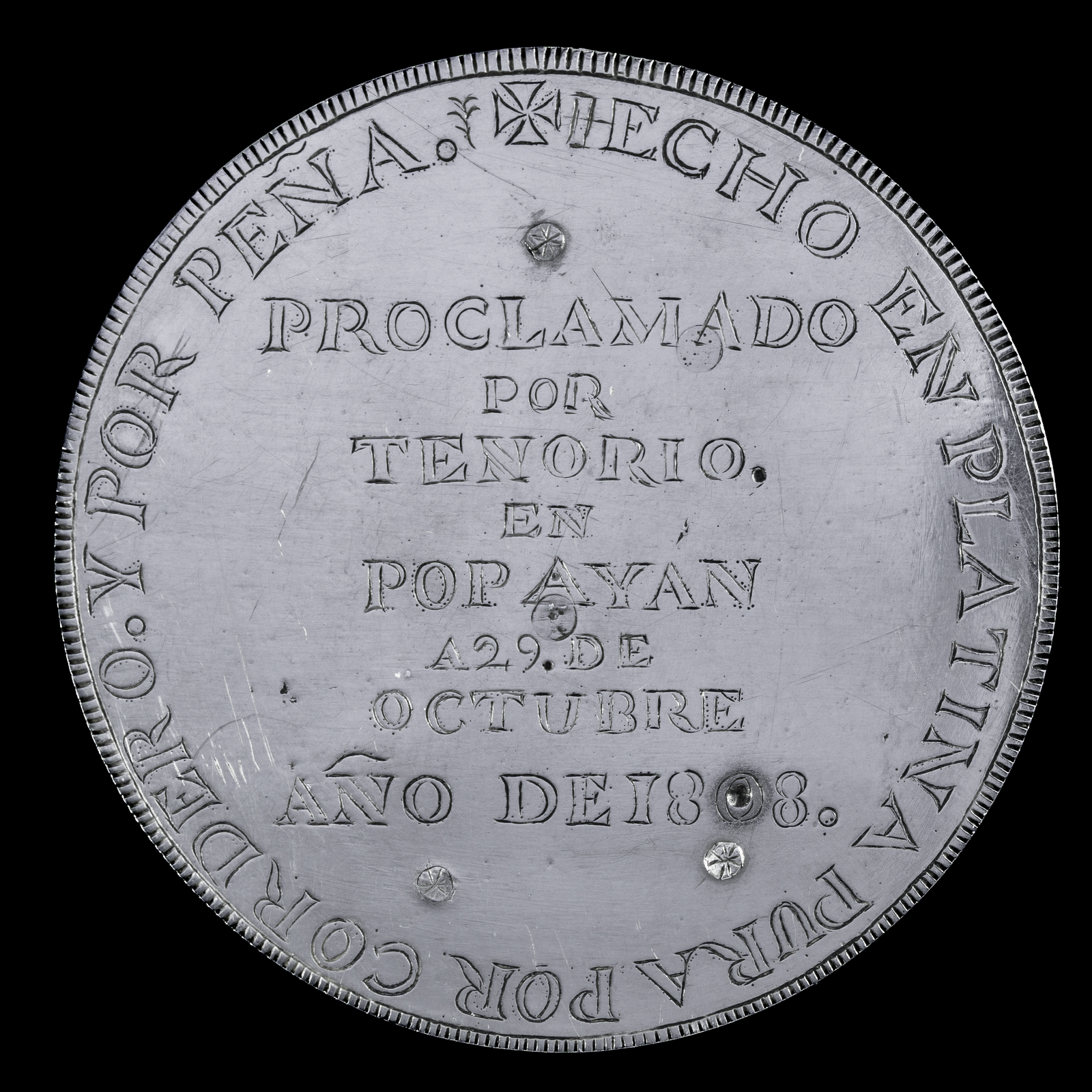
Lote 137 – Medalla de Proclamación de Fernando VII 1808
Auction Expired
Popayan
Platino
77.15 Gr
62 mm Ø
AU
Item condition: Used
Auction Expired because there were no bids
Descripción
Anverso: Busto a la derecha de Fernando VII con uniforme militar, dentro de la leyenda FERDINANDVS · VII · D · G · HISPANIARVM · ET · INDIARVM · REX, con borde denticulado. Reverso: PROCLAMADO POR TENORIO EN POPAYAN A 29 DE OCTUBRE AÑO DE 1808, dentro de la leyenda HECHO EN PLATINA PURA POR CORDERO Y POR PEÑA. Peso: 77.15 gramos Diámetro: 62 mm Metal: Platino, y cobre. Ver estudio metalográfico Medalla única, fundida, que identifica explícitamente el metal de composición, platina, así como a los plateros responsables, Manuel María Cordero y Joaquín Peña, y al comitente Antonio Tenorio, documentado como Alférez Real de Popayán y miembro de una de las familias más poderosas e influyentes de la ciudad, además de tío de Francisco José de Caldas, figura central del pensamiento ilustrado neogranadino y mártir de la Independencia. La prestigiosa pero muy ceremonial posición de Alférez Real exigía que éste se hiciese cargo de las ceremonias en la ciudad y en especial aquellas relacionadas con los eventos de coronación y le obligaba a financiar la hechura de las medallas de proclamación, como es ésta. El material utilizado fue extraordinario para su época. La platina pura aquí mencionada corresponde a platino nativo deliberadamente aleado con cobre, ya que por su alto grado de fundición la tecnología para el refinado del platino puro aún no existía . Este metal solo podía trabajarse mediante fundición, no acuñación, y la pieza constituye la primera ejecución exitosa de una obra ceremonial de gran formato en platina bajo condiciones coloniales. Análisis modernos mediante fluorescencia de rayos X realizados por el Goldsmiths Company Assay Office de Londres confirman una aleación platino cobre con variaciones composicionales características de la platina colombiana nativa, distinta del platino refinado industrial posterior. El busto fue ejecutado por separado como elemento escultórico en alto relieve y posteriormente aplicado al campo, integrándose mediante un elaborado trabajo de cincelado, pulido y grabado. La calidad escultórica es excepcional, con rasgos faciales finamente modelados, cabello individualmente trabajado y uniforme militar detallado con banda, charreteras y condecoraciones. Tres puntos cincelados con técnica magistral simulan diamantes, generando efectos ópticos mediante reflexión de la luz, evidencia de una ejecución técnica plenamente dominada. No es de extrañar que Popayán, cuna de grandes joyeros como lo atestiguan las custodias coronas y exuberantes joyas (e.j. La Lechuga), sirviera de laboratorio para los adiestrados artesanos joyeros que fueron Cordero y Peña se adentraran en la novedosa orfebrería en platino. La medalla se produce en el contexto de la crisis de legitimidad tras las Abdicaciones de Bayona, cuando la autoridad de Fernando VII fue reafirmada en América mediante actos jurídicos formales. Es reconocida universalmente como la medalla de proclamación más importante de América Latina y una de las piezas ceremoniales más significativas de toda la numismática colonial española. Aunque proclamada en Popayán, el metal proviene de los depósitos aluviales del Chocó y Citará, únicas fuentes de platina dentro del Imperio español. Este material, naturalmente heterogéneo y de difícil trabajo, demuestra aquí que podía ser aleado, fundido y terminado con alto nivel técnico, antecedente directo de los debates sobre su posible uso monetario, finalmente descartados por impracticables. En la literatura ocupa un lugar singular. José Toribio Medina le dedicó una entrada exclusiva en Monedas y Medallas Hispano- Americanas (1891), ilustrándola y separándola de todas las demás medallas de proclamación, distinción única. Posteriormente fue estudiada por Benjamin Betts en el American Journal of Numismatics (1912) y reafirmada por autores posteriores como Almánzar. Medina la consideró de tal importancia que la retuvo en su colección hasta su dispersión tardía por su familia. Su procedencia completa e ininterrumpida, desde la colección Medina pasando por Alamiro de Ávila hasta Carlos Alberto Cruz, una de las colecciones más importantes de América del Sur, confirma su carácter único y definitivo. No se conoce otra medalla de proclamación en platina. Más rara y significativa que muchas medallas de oro, constituye la pieza clave de las proclamaciones latinoamericanas y una de las mayores rarezas de la numismática mundial. __________________________________________ Obverse: Right-facing bust of Ferdinand VII in military dress, within legend FERDINANDVS · VII · D · G · HISPANIARVM · ET · INDIARVM · REX inside a denticulated rim. Reverse: PROCLAMADO POR TENORIO EN POPAYAN A 29 DE OCTUBRE AÑO DE 1808 within legend HECHO EN PLATINA PURA POR CORDERO Y POR PEÑA. 77.15 grams 62 mm This unique, hand-cast medal explicitly names both the compositional metal of platinum and the silversmiths who made the medal, Manuel María Cordero and Joaquín Peña, as well as the name of Antonio Tenorio, who commissioned and financed its production, documented as Alférez Real of Popayán and a member of one of the wealthiest and most influential elite families of the city, in fact the nephew of Francisco José de Caldas (El Sabio Caldas), a central intellectual and political figure of late colonial New Granada and later a martyr of Independence. The source material for this medal was revolutionary and only such a powerful family as Tenorio could produce something so different. Platina pura in this case refers to a native-found platinum deliberately alloyed with copper, as refined pure platinum was neither available nor possible at the time. It could only be cast, not struck, and this medal demonstrates the first successful execution of large scale ceremonial work in platina under colonial conditions. Modern non-destructive X-ray fluorescence analysis conducted by the Goldsmiths Company Assay Office in London confirms a platinum-copper alloy with marked compositional variability, a diagnostic signature of native Colombian platina and different from later, industrially-refined platinum. The bust of Ferdinand VII on this piece was executed separately as a sculptural element in high relief, then applied to the field and fully integrated through extensive hand chasing, polishing, and engraving. The bust displays exceptional sculptural quality, with finely modeled facial features, individually chased hair, and detailed military dress including sash, epaulettes, and decorations, demonstrating confident technical mastery rather than experimental effort. Three distinct chased points executed in such a manner that they visually resemble diamonds appear in three areas of the design, a deliberate optical effect produced by burin work of high expertise and intended to animate the surface through reflected light. Produced at the height of the legitimacy crisis following the Abdications of Bayonne, when Ferdinand VIIs authority could no longer be presumed and was reaffirmed in the Americas through formal juridical acts, this unique medal is universally recognized as the most important proclamation medal of Latin America and among the most significant ceremonial numismatic objects of the entire Spanish colonial series. Although proclaimed in Popayán, the metal for this piece originated from the alluvial deposits of the Chocó and Citará regions, the only sources of platinum exploited within the Spanish Empire, where platina occurred as naturally heterogeneous placer material, notoriously difficult to work. In this sense, the medal constitutes material proof that platina could be deliberately alloyed, cast, and finished to a high standard under colonial conditions, a reality that predicated discussions on the possible use of platinum for coinage, although those proposals were ultimately dismissed as impractical. This medal occupies a unique position in the literature. José Toribio Medina devoted an exclusive entry to this single piece in Monedas y Medallas Hispano Americanas(Santiago de Chile, 1891), illustrating it with a dedicated drawing and treating it separately from all other proclamation medals, a distinction accorded to no other medal. It was further discussed by Benjamin Betts in the American Journal of Numismatics (1912) and reaffirmed by later scholars including Almánzar. Medina himself regarded the medal as so rare and important that he retained it when dispersing his collection, releasing it only later through his family. Its complete and uninterrupted pedigree through the Medina Collection, Alamiro de Ávila, and Carlos Alberto Cruz, whose collection of colonial silver and ceremonial objects ranks among the greatest ever formed in South America, confirms its status as the unique, original, and definitive example. No other proclamation medal in platina is known. Rarer and more significant than many gold proclamation medals, this piece stands as the cornerstone proclamation medal of Latin America and one of the greatest rarities of world numismatics.
Total Bids Placed:
Auction has expired
Auction Expired because there were no bids
| Inicio de puja por sistema | mayo 15, 2026 10:00 am |